
From forest to frame: How we grade the oak in your self-build
Every oak frame starts life as a tree, but not every tree makes the cut. Here's how we choose the timber that becomes your home.
Why French oak?
Most of our oak comes from six sawmills across Normandy and Burgundy, two of France's great oak-growing regions. The reason is simple: scale. France has around 17 million hectares of forest, and hardwoods, overwhelmingly oak, make up roughly two-thirds of the country's standing timber stock. The UK's woodland is a fraction of that size, and much of it is open grown, with trees spaced far apart. That produces short, branchy trunks that make poor framing timber. Densely planted French forest, by contrast, forces trees to grow tall and straight, exactly what a structural oak frame needs.

The grading ladder
Before any beam reaches our yard, it's already been sorted. At the very top is oak destined for wine and whisky barrels, flawless, knot-free timber, one grade above anything we use. Below that is furniture-grade, then structural framing oak, which is where we buy.
In the UK, structural hardwood is assessed under BS 5756, the visual grading standard for temperate hardwoods, which sorts timber into TH1, and TH2 grades based on slope of grain, knot size and position, and sapwood content. TH1 is the higher grade. These visual grades link to the European strength classes set out in EN 338, where oak destined for load-bearing frames typically falls into class D30 or D40, the "D" denoting density-related strength.

Our own visual benchmark
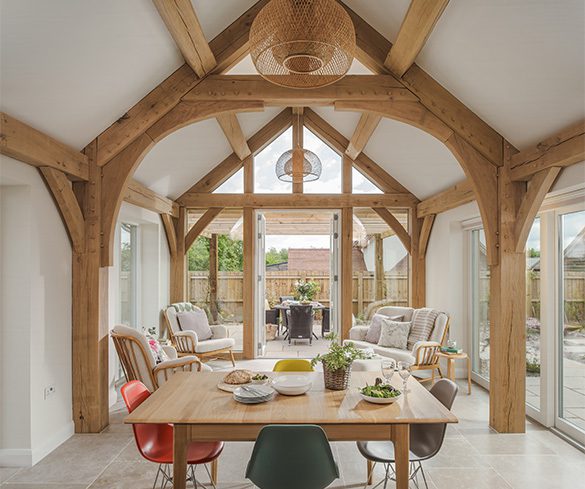
On top of the official standards, we apply our own QP1 grading at the sawmill: straight grain, minimal sapwood, and only small, well-placed knots. It's this visual clarity, not just structural strength, that matters most for the big, exposed timbers that define an oak-framed home. A beam with a large shake or cluster of knots might be structurally sound, but if it fails on appearance, it doesn't make it into your frame.

Nothing goes to waste
Rejected timber isn't wasted, mills typically replace it, and it's sold on regionally, often ending up in barn conversions or auction houses, where visual perfection matters less than structural performance.

Built to outlast us
Oak is a genuinely sustainable building material. The trees we use are typically 80-120 years old when felled, locking decades of carbon into every beam. A well-built oak frame can stand for three to four centuries, and timber from frames eventually taken down is usually reused rather than discarded. Our timber is sourced from forests independently certified under recognised international sustainable forestry schemes, which verify that harvesting is legal, responsibly managed, and matched by ongoing replanting.
Take your next step